

The delivery address rules MyCNBox applies, one by one
Seven rules, each quoted from the MyCNBox help centre and read on 10 November 2026. Two can stop a parcel, one makes a typo permanent, and the rest decide what you might pay at the far end.
- From
- MyCNBox warehouse, in China
- To
- An overseas address that matches your billing address
- Help articles
- 10, 21, 26, 42, 43, 46, 51, 55, 74, 160, 165
- Second read
- 9 and 10 Nov 2026, wording unchanged
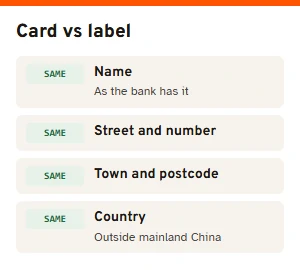
The billing address and the delivery address have to match
Due to fraud risk, we don't support any shipment to China mainland address. The receipt address must be the same of your payment billing address.
MyCNBox help article 43, read 10 November 2026
“Receipt address” here means the address on the parcel label. “Payment billing address” is the address your card issuer or wallet holds for you, the one the bank compares during a 3DS check. MyCNBox asks for the two to be the same, and the reason it gives is fraud risk.
In practice that rules out a few everyday arrangements: a parent's card paying for a delivery to a student flat, a work card paying for a parcel sent home, or an old card still registered at the address you moved out of. The fix is on the payment side. Pay with a card or wallet billed to the delivery address, or update the billing address with your bank before you check out.
The same billing details come up again if a card payment fails: help article 67 lists the card number, the name and the billing address as the first things to check. The payment page covers that side.
Overseas addresses only, and no other agent's warehouse
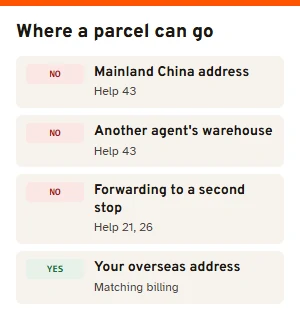
Help article 43 is answering a specific question: can MyCNBox send a parcel to a Chinese address or to another agent's warehouse? The answer is no to both, and the article draws the conclusion itself: “So it must be an oversea address”.
Forwarding is refused separately. Article 21 says MyCNBox does not forward orders or ship to “any other domestic address”, and article 26 opens with the same point when a seller offers a free extra: the seller has to issue a ¥1 link that you order through MyCNBox, with a remark saying what it is, because the warehouse will not take in parcels it has no order for.
So the chain is short and fixed: seller, MyCNBox warehouse in China, your overseas address. There is no second agent, consolidator or friend's flat in the middle.
The second address check, at packing
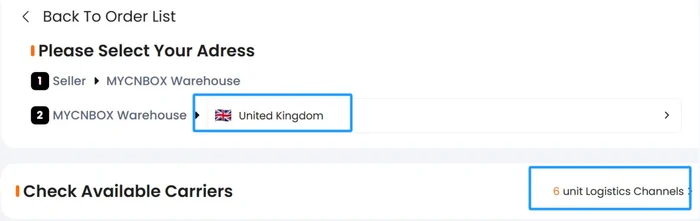
You meet the address twice. The first time is when you pay for the item: the checkout asks which country the parcel will eventually go to and shows how many logistics channels serve it, as in the official desktop guide below. Nothing is locked yet at that point.
The second time comes once everything has arrived and you turn it into a parcel. Help article 10 lists the order: enter the overseas address, choose any packing add-ons, pick the shipping channel, then decide on insurance and the declared value. Against step one it adds the warning that matters: “please make sure to double-check or verify it on Google, as once the international package is shipped, the address cannot be modified or updated.”
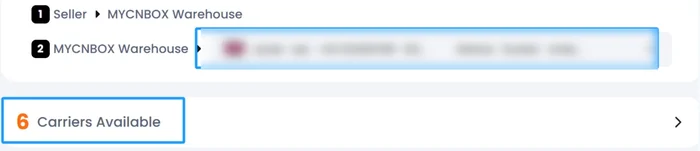
The timetable is quick, which is why the check has to happen before you pay. Packing takes up to one business day after you submit, and dispatch up to one business day after the shipping fee clears (help article 42). A typo spotted on the third day is already on a plane. Check the house number, the flat or unit, the postcode and the spelling of the town against a map search, and make sure a phone number that a local courier can actually ring is on the label.
Remote towns and the courier's own surcharge list
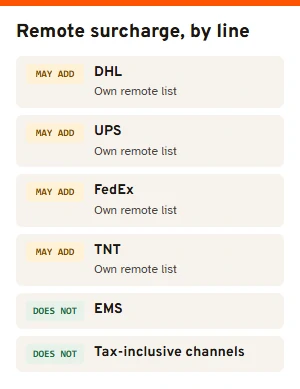
Remote-area surcharges belong to the couriers. Help article 51 explains that standard international rates cover major cities, that “major couriers like DHL, UPS, FedEx, and TNT often charge remote area surcharges”, and that “EMS and tax-inclusive channels do not”. Each courier keeps its own list, and MyCNBox says it charges “the exact amount set by the courier”.
Remote is wider than it sounds. The article's own examples are secluded towns and island nations, and delivery times to those places can stretch too. Look your postcode up on the courier's website before picking an express line, and if it is listed, compare the express price with EMS or a tax-included line, which the same article says do not add the surcharge.
The EU budget line has a separate limit: its notice says remote regions may not be supported at all (help article 160), which is a coverage question rather than a fee.
Duty included in the line price, or billed later
Every shipping channel carries a description, and according to help article 46 that description says whether customs duties are included. On the phone screens in the official guide the labels look like the picture below: a tax tag on the card and a first line that reads “Tax-inclusive special line”.
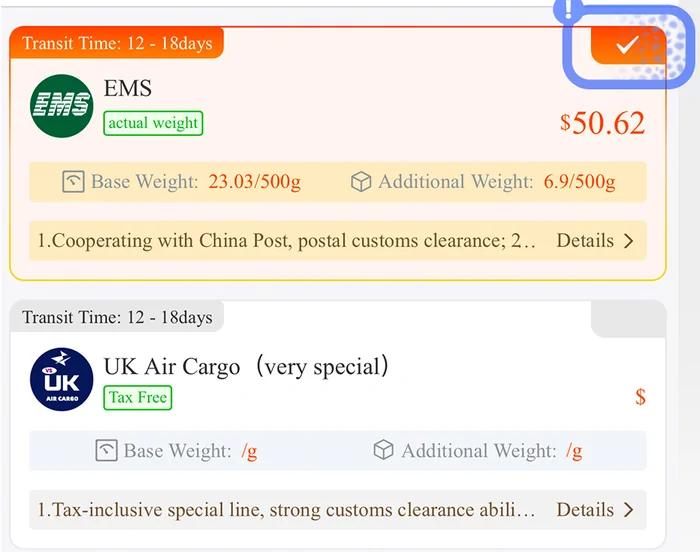
A line marked [tax excluded] is a different deal. Help article 74 says such parcels may be flagged and charged import duty, that duty can range from 0% to 100% of the declared amount, and that for express services such as UPS the bill may come after the parcel has been delivered, sometimes well after. If the carrier bills MyCNBox as the sender, MyCNBox passes the bill on to you. Refusing or delaying payment can send the parcel back to China.
One practical difference for tracking: some tax-included special lines do not show on 17track, so help article 55 asks you to give customer service the tracking number and let them check the provider's own system.
For readers in the UK and the US the advice is the same two lines. Read whether the channel description says tax included before you pay, and if you choose an express courier, look your town up on that courier's remote list.
Parcels for EU addresses since 22 October 2026
MyCNBox published an EU shipping notice dated 22 October 2026 (help article 165). It describes three changes, and the infographic that came with it sums them up:
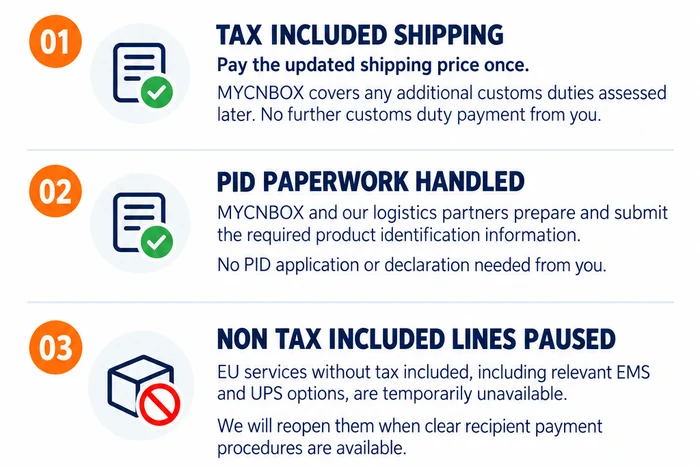
- Tax-included EU lines cost EUR 2 more per parcel. Once the shipping is paid, MyCNBox says it covers any customs duty assessed later on that parcel, and asks you to contact it if a duty demand arrives anyway.
- Product identification (PID) is done for you. MyCNBox and its logistics partners prepare and submit the PID data; you do not need product codes.
- Options without import tax included are paused. The notice names the relevant EMS and UPS services and says they will reopen once EU customs authorities publish clear guidance on how recipients pay.
Separately, help article 160 announced a budget EU line, EUR Air Cargo-SS (Preferential): lower cost, 20 to 30 working days, roughly the first two weeks possibly without tracking because of airport queues, and remote regions possibly not served. The notice itself says not to choose it if you need speed. Article 165 carries its own date and article 160 does not; we re-read both on 10 November 2026 and log any change on notices and edits.